Two roads open up for almost every commerce student after graduation: chasing the CA badge, or cracking a banking exam like IBPS PO. Both are respected, both pay well eventually, and both are advertised as “safe” careers — but they ask very different things of you along the way. If you’ve been turning over Which Commerce Career Path Is Best for your own goals, timeline, and temperament, here’s a grounded comparison to help you decide with clarity instead of guesswork.
The Chartered Accountancy Route
CA is the deeper, more technical path — and it pays for that depth over time.
- Timeline: around 4–5 years in total, including the mandatory 2-year articleship under a practicing CA, across the Foundation, Intermediate, and Final levels.
- Starting pay: ₹7–12 LPA at most companies, with Big 4 firms (Deloitte, EY, PwC, KPMG) offering similar or slightly higher packages for audit, tax, and advisory roles.
- Placement trend: campus placement averages have climbed toward ₹11–11.5 lakh per annum in recent ICAI placement drives, with top domestic offers touching ₹28 lakh and above.
- Ceiling: genuinely high — CFOs and Big 4 partners regularly cross ₹60 lakh, and many go well past ₹1 crore annually.
- What it demands: patience through a multi-year, multi-stage exam cycle, comfort with numbers and constantly changing regulations, and the discipline to study while working through articleship.
For the latest exam pattern, registration windows, and syllabus, visit ICAI’s official website — it’s the only authoritative source for CA exam updates.
The Banking Route (IBPS PO and Beyond)
Banking offers a shorter runway to a stable salary, with growth that’s slower but far more predictable.
- Entry: a single all-India exam — commonly IBPS PO or SBI PO — conducted by the Institute of Banking Personnel Selection, open right after graduation.
- Starting pay: basic pay of roughly ₹48,480/month under the current bipartite settlement, with gross salary between ₹78,000–₹91,000/month once allowances are added.
- Security: a defined 2-year probation before confirmation as a Scale-I officer, plus pension-linked benefits, medical cover, and leased accommodation in many postings.
- Growth: promotions run from Scale I to Scale VII over roughly 25–30 years — mid-career Scale IV officers earn around ₹1.2–1.5 lakh/month, and senior GM-level executives can cross ₹2.5–3.5 lakh/month.
- What it demands: strong quantitative and reasoning skills for a single competitive exam, and comfort with people-facing, operations-heavy branch work.
Exam calendars and official notifications are published only on the IBPS official website — always the first place to check before trusting a coaching site’s dates.
Which Commerce Career Path Is Best? Key Differences
- Time to first salary: Banking pays sooner (1 exam cycle); CA takes years longer (articleship plus three exam levels).
- Growth ceiling: CA has a higher long-term ceiling, especially in Big 4 leadership or CFO roles; banking growth is steadier but capped by seniority timelines.
- Risk vs. certainty: CA has a tougher pass rate and no guaranteed placement; banking, once you clear the exam, offers near-guaranteed job security.
- Work style: CA work is deadline- and audit-season-heavy; banking runs on more structured, branch-hours schedules.
There’s no universally “better” answer — the right pick depends on whether you value a higher ceiling and are willing to grind for it, or a faster, steadier climb.
Building Either Path at Gurukul Degree College
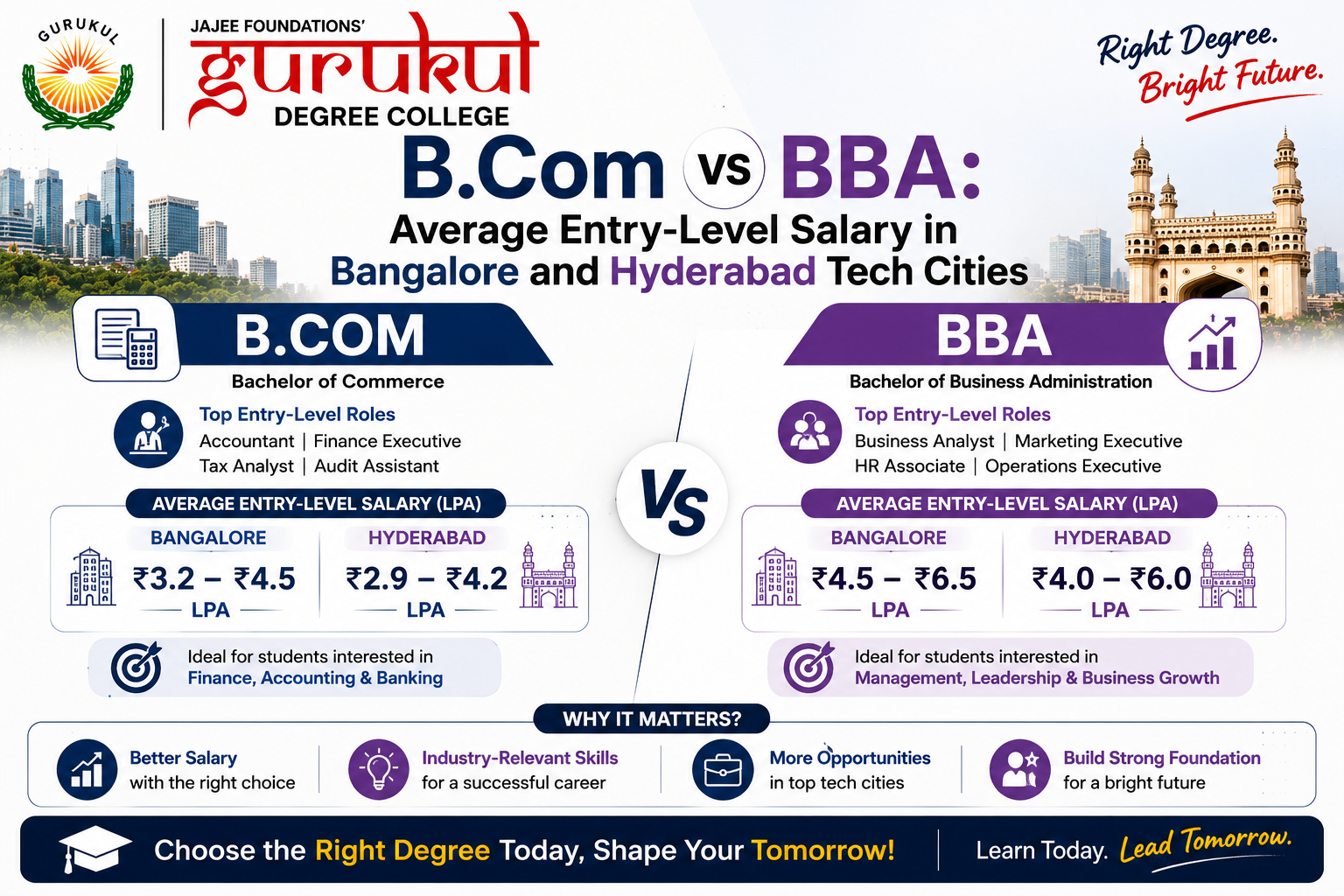
Whichever direction you lean toward, the foundation is the same: a strong B.Com or BBA base in accounting, finance, and business fundamentals. The BBA and B.Com programs at Gurukul Degree College are built around exactly this — solid fundamentals, career counselling, and exposure to finance and banking-oriented electives that make it easier to pursue CA articleship or start preparing for banking exams right after graduation.
To know more about eligibility, seats, and how the college supports students heading into CA or banking careers, reach out through the admissions page.
Bottom Line
If you like numbers, don’t mind a multi-year grind, and want the highest possible earning ceiling, CA is worth the wait. If you’d rather start earning sooner with strong job security and a clear, government-backed growth ladder, banking is the smarter first move. Either way, the commerce foundation you build today at Gurukul Degree College is what makes both doors easier to open.