How Can PU Colleges Prepare Students for the Future Job Market?
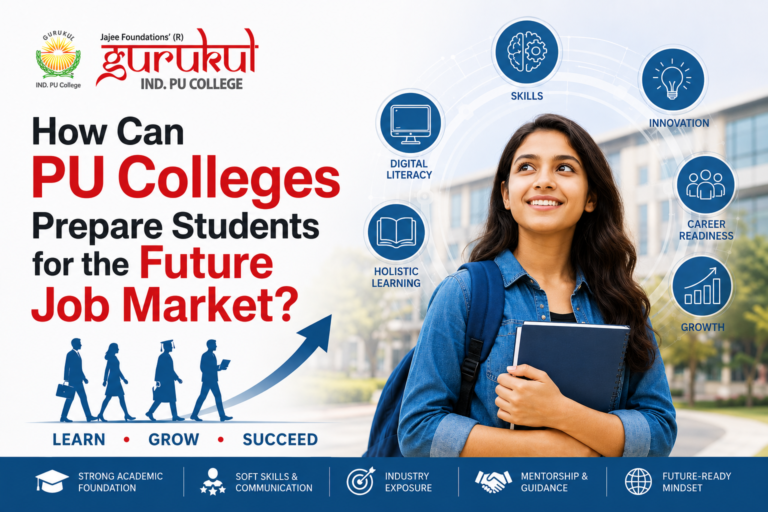
A few years ago, good marks felt like the finish line. Today, they’re just the starting point. Board exam scores still matter, but they no longer tell the full story of whether a student is ready to work. Employers, universities and even AI tools are quietly rewriting what “ready” means — and PU colleges are where that shift either takes root or gets missed entirely.
If you’re a parent or student trying to figure out what genuinely prepares someone for the future job market, here’s an honest look at what’s working in PU education right now — and where it still falls short. (Skip ahead to see how one college is putting this into practice.)
Why the Future Job Market Looks So Different Now
The World Economic Forum’s Future of Jobs Report 2025 estimates that around 170 million new roles will appear by 2030 while roughly 92 million existing ones disappear — a net gain, but a messy, fast-moving one. Nearly 4 in 10 core skills used on the job today are expected to change in that same window. That’s the scale of disruption today’s PU students will graduate into.
India isn’t standing outside this trend. The National Education Policy 2020 was built around exactly this concern, pushing vocational exposure and skill-based learning into school and college years instead of saving it for after graduation. The message for PU colleges is clear: a syllabus alone no longer prepares a student for the future job market. The approach to learning does.
What PU Colleges Actually Need to Teach — Beyond the Textbook
Strong PU colleges are already weaving a few things into everyday classroom life:
• Digital and AI literacy — comfort with spreadsheets, online research, and everyday AI tools, not fear of them.
• Communication over memorisation — explaining an idea clearly is becoming as valuable as knowing it.
• Project and case-based learning — debates, presentations, and real problems instead of pure answer-key practice.
• Early, honest career guidance — students choosing Science, Commerce or Arts without understanding where each path leads is still far too common.
• Real-world exposure — internships, guest lectures, and small projects that mirror actual workplaces.
None of this replaces strong fundamentals — it builds on them.
A Practical Example: Gurukul Independent PU College
This is where the specific college a student picks starts to matter more than people admit. Gurukul Independent PU College, in Kalaburagi, is a useful example of this shift in practice. Alongside its Science and Commerce streams, the college leans on well-equipped labs, structured mentoring, and merit-based scholarship routes such as the Gurukul Eligibility Entrance Test to push students toward genuine understanding rather than memorisation — the kind of foundation that travels well into competitive exams, professional courses, and eventually the future job market.
If you’re comparing PU colleges, it’s worth looking at how Gurukul Independent PU College structures its courses and mentoring, or simply getting in touch with the college directly to ask how they balance results with skill-building — that conversation usually says more than any brochure.
What Students Can Do Right Now, Regardless of College
• Pick up one practical skill outside the syllabus each semester — spreadsheets, basic coding, design, or public speaking.
• Use free, credible tools such as India’s National Career Service portal for career guidance and aptitude assessments.
• Talk to people already working in fields you’re curious about — a handful of honest conversations teaches more than dozens of articles.
• Don’t wait for “placement season” to think about employability — start building it from 1st PU.
The Bottom Line
No college can predict exactly what the job market will look like in 2030 — no one fully can. But PU colleges that build curiosity, real skills, and confidence alongside textbook knowledge give students a genuine shot at adapting to whatever comes next. That’s a far better bet than chasing marks alone, and it’s the difference between a college that teaches for exams and one that teaches for the future job market.
FAQ
Popular Question
The future job market refers to the changing employment landscape driven by technology, artificial intelligence, automation, and new industry demands. It focuses on skills, adaptability, and continuous learning rather than just academic qualifications.
Preparing early helps students develop the skills, knowledge, and confidence needed to succeed in emerging careers. It also allows them to make informed decisions about higher education and career paths.
PU colleges can prepare students by offering skill-based learning, digital literacy training, communication development, career guidance, project-based learning, and real-world exposure through workshops and internships.
Some of the most important skills include digital literacy, AI awareness, communication, critical thinking, problem-solving, teamwork, creativity, and adaptability.
Subcribe Our Newsletter
Work Hours
- Mon - Fri :
- Sunday :
- 10.00 AM - 05.30 PM
- Closed