Do employers care more about skills or college credentials?
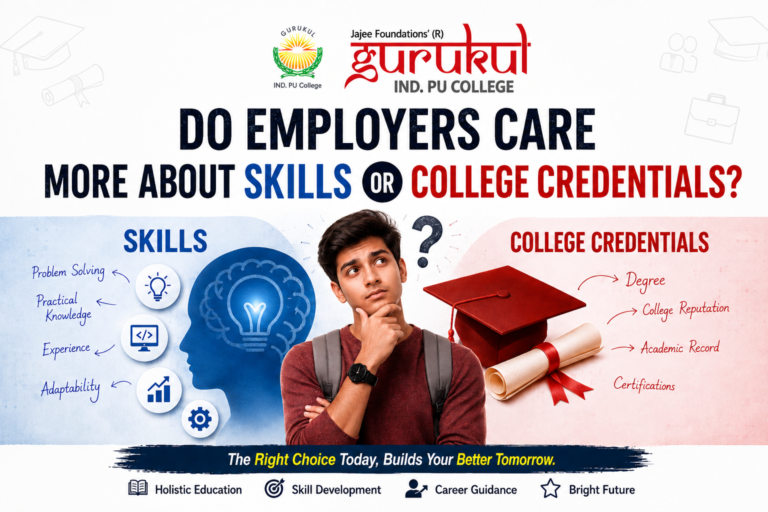
Picture two candidates for the same job. One has a shiny degree and a thin resume. The other has no degree but a portfolio full of real, finished work. Ten years ago, the choice was obvious. Today? It’s genuinely not. So let’s settle it: do employers care more about skills than they care about where — or whether — you went to college? The honest answer is “it depends,” but the data points in a clear direction, and it’s one every student and parent planning for college should understand.
What Employers Are Actually Saying in 2026
Every year, the National Association of Colleges and Employers surveys hundreds of hiring organizations about how they actually recruit. Its Job Outlook 2026 report found that 70% of employers now use skills-based hiring, up from 65% the year before, and that grades have quietly stopped being a reliable filter: only 42% of employers now screen candidates by GPA, down from 73% back in 2019.
That’s not a fringe trend. It’s a steady, multi-year shift away from “where did you study” and toward “what can you actually do.”
The Numbers Behind the Shift
McKinsey’s workforce research is the statistic recruiters quote most often: hiring for demonstrated skills predicts job performance roughly five times better than hiring on education alone, and more than twice as well as hiring on past work experience. Employees hired this way also tend to stay in their roles noticeably longer, which is exactly why cost-conscious companies are paying attention.
But there’s an honest wrinkle here. Indeed’s Hiring Lab has found that degree requirements haven’t disappeared — they’ve simply concentrated in specific fields (government, law, healthcare, finance) and specific cities, while fading everywhere else. Skills-first hiring is real, but it isn’t evenly distributed.
Where a Degree Still Pulls Its Weight
None of this means a degree is worthless — far from it. Regulated professions like medicine, law, engineering, and teaching still require formal qualifications by law, not by preference. A degree also builds things a certificate rarely can on its own: sustained discipline, exposure to different ways of thinking, and a foundation broad enough to pivot careers later. The honest picture is less “skills vs. degree” and more “skills plus direction.” Employers increasingly want proof you can do the job — and a degree is one of several ways to build and show that proof, not the only one.
Where Schools and Colleges Fit In
This is exactly the gap that forward-looking institutions are trying to close at the pre-university stage, before students even reach the job market. At Gurukul Independent PU College, for instance, the approach pairs strong Science and Commerce academics with structured mentorship, activity-based learning, and early exposure to real-world problem-solving — so students leave with both a solid academic record and the practical habits employers are now screening for. You can see how this plays out across their PU courses and streams or explore their broader campus and admissions details directly on the Gurukul Group of Institutions site. The logic is simple: a strong PU foundation, built the right way, makes it far easier to add job-ready skills later, whether through a degree, a certification, or hands-on project work.
So, Do Employers Care More About Skills? Here’s the Real Answer
Yes — increasingly, employers care more about skills for the initial screen and interview stage, especially outside regulated professions. But a degree still opens doors, still matters for long-term career mobility, and still signals commitment that a short course can’t always replicate. The safest strategy for any student isn’t choosing one over the other. It’s building a strong academic base and stacking real, demonstrable skills on top of it, starting well before graduation.
Three Things Students Can Do Right Now
1. Build a portfolio, not just a transcript. Projects, competitions, and internships show what a mark sheet can’t.
2. Choose a PU stream with skill-building baked in. Look for colleges that pair academics with mentorship and practical exposure — explore Gurukul’s admissions process as one example of what to look for.
3. Keep learning after you enroll. Certifications and workshops compound the value of whatever degree you eventually choose.
FAQ
Popular Question
Yes, many employers today prioritize practical skills, problem-solving abilities, and real-world experience during the hiring process. However, a college degree remains important for many careers, especially in regulated professions like medicine, engineering, law, and teaching.
Employers care more about skills because they demonstrate whether a candidate can perform the job effectively. Technical expertise, communication, teamwork, and critical thinking often have a greater impact on workplace success than academic qualifications alone.
In many industries, employers value both skills and experience. If you have relevant skills gained through internships, projects, certifications, or freelance work, you can still stand out even with limited professional experience.
Yes. A college degree continues to provide strong academic knowledge, credibility, and career opportunities. While skills are becoming increasingly important, combining a degree with practical skills gives students the best competitive advantage.
Subcribe Our Newsletter
Work Hours
- Mon - Fri :
- Sunday :
- 10.00 AM - 05.30 PM
- Closed