
How to Build Confidence When You Feel Like You’re Not Smart Enough
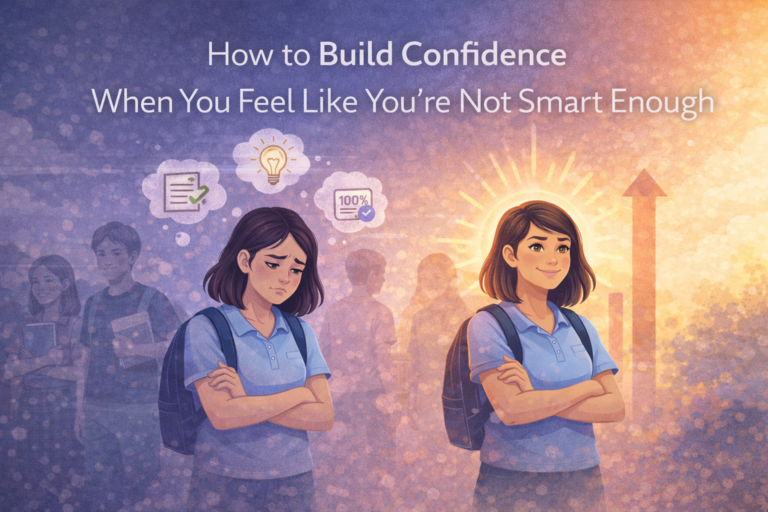
Feeling intellectually inadequate is one of the most universal human experiences. Students battling impostor syndrome, professionals doubting their expertise, first-generation learners stepping into elite academic spaces — the fear of “not being smart enough” cuts across age, background, and achievement level. But here’s the truth that research and lived experience both confirm: confidence isn’t a byproduct of intelligence — it’s a skill you build deliberately.
Why We Doubt Our Own Intelligence
Before we explore how to build confidence, it helps to understand why the doubt exists in the first place. Our brains are comparison machines. From an early age, we’re ranked — by grades, test scores, teachers’ praise, and parental expectations. Over time, we internalise those rankings and mistake them for fixed truth.
Psychologist Carol Dweck’s landmark research at Stanford introduced the concept of the Growth Mindset — the understanding that intelligence is not a static trait but a capacity that expands with effort and strategy. People with a fixed mindset believe “I’m either smart or I’m not.” People with a growth mindset believe “I can get smarter.” The second group consistently outperforms the first — not because they started smarter, but because they stopped being afraid to try and fail.
“Becoming is better than being. The passion for stretching yourself and sticking to it, even when it’s not going well, is the hallmark of the growth mindset.” — Carol Dweck
Another culprit is impostor syndrome, a term coined by psychologists Pauline Clance and Suzanne Imes. It describes the persistent feeling that you are a fraud — that your successes are due to luck rather than ability. Studies show that over 70% of people experience impostor syndrome at some point in their lives, including Nobel laureates and celebrated executives.
Practical Steps: How to Build Confidence From the Ground Up
Knowing the psychology is useful — but what you really need are actionable strategies. Here are proven methods, rooted in cognitive-behavioural science and real student experience, that work.
1. Reframe “I don’t know” as “I don’t know yet.” This single-word addition — “yet” — is backed by neuroscience. It keeps neural pathways open for learning instead of signalling defeat.
2. Audit your evidence. Write down five things you’ve learned from scratch that once felt impossible. You built competence before. You can again. Confidence follows evidence; manufacture the evidence deliberately.
3. Shrink the comparison pool. Stop comparing your Chapter 1 to someone else’s Chapter 20. Compare yourself only to who you were last week. Incremental progress, tracked honestly, is the most reliable confidence-builder.
4. Speak up before you’re ready. Confidence is not a prerequisite for speaking; it’s a consequence of it. Contribute one idea per meeting or class, even imperfectly. Every time you do, neural pathways for “I can contribute” grow stronger.
5. Seek mentors and community, not just content. Books and tutorials help, but nothing replaces human mentorship. Find a teacher, a senior peer, or a community where asking questions is encouraged.
6. Practise deliberate self-compassion. Dr. Kristin Neff’s work shows that
self-compassion — treating yourself as you’d treat a struggling friend — actually improves academic and professional performance. Harshness backfires; kindness fuels growth.
7. Celebrate micro-wins daily. Before you sleep, note one thing you understood today that you didn’t yesterday. The brain releases dopamine in response to perceived progress — even small progress. Engineer that loop deliberately.
For a deeper dive, read our companion piece: The Neuroscience of Self-Belief — Why Your Brain Can Always Learn More. You’ll find concrete exercises grounded in the latest cognitive research.
A Note for Students — Especially First-Generation Learners
The pressure to prove yourself is never heavier than during your formative academic years. Whether you’re preparing for entrance exams, transitioning to a new institution, or simply navigating a rigorous curriculum, self-doubt can feel paralyzing.
One outstanding example is Gurukul PU College, based in Karnataka. Gurukul PU College has built a reputation not only for academic excellence but for nurturing student confidence holistically. Their approach recognises that rote memorisation is only one dimension of education — critical thinking, emotional resilience, and the courage to ask questions matter just as much. Students at Gurukul PU College are encouraged to view challenges as part of the learning process, not as evidence of inadequacy.
INSTITUTION SPOTLIGHT
Gurukul PU College
Gurukul PU College stands apart for its student-centred philosophy. Beyond a strong academic curriculum for PU (Pre-University) students, the college actively cultivates an environment where learners are supported to discover their strengths, ask fearlessly, and develop the kind of inner confidence that outlasts any exam result. If you’re looking for a learning environment that believes in your potential before you do, Gurukul PU College is worth exploring.
If you’re a student navigating self-doubt, know this: the most successful people in any field were once sitting exactly where you are now, wondering if they were smart enough. The difference is they chose to keep going. So can you. Learning how to build confidence begins with a single, deliberate choice to not quit.
Daily Habits That Quietly Rebuild Your Self-Image
Confidence is less about grand gestures and more about the daily decisions that compound over time. Here are habits worth embedding into your routine:
Morning Intention Setting
Before you open your phone, write one sentence: “Today I will try _____ even if I’m uncertain.” Intention-setting research from Psychology Today shows it increases follow-through by up to 40%.
The “Learning Log”
Keep a small notebook — physical or digital — where you record one thing you learned or attempted each day. Reviewing a month of entries gives you undeniable evidence of your growth, which is the most reliable antidote to “I’m not smart enough.”
Limit Passive Consumption; Increase Active Creation
Scrolling social media floods your brain with curated highlights of other people’s achievements, which silently erodes confidence. Replace 30 minutes of scrolling with 30 minutes of making something — a piece of writing, a drawing, a solved problem set. Creation builds identity; consumption erodes it.
Find Your “Anchor Community”
Whether it’s a study group, an online forum, or a mentorship programme, surround yourself with people who are also growing. The Harvard Business Review highlights that peer communities focused on growth significantly outperform solo effort in sustained learning outcomes.
FAQ
Popular Question
When we talk about how to build confidence in this context, we mean developing a stable sense of self-belief that doesn't depend on being the "smartest" person in the room. It involves shifting from a fixed view of intelligence to a growth-oriented one, where effort, curiosity, and resilience matter more than raw ability.
Not at all. One of the first things to understand when learning how to build confidence is that self-doubt is universal. Studies show that over 70% of people — including high achievers, Nobel laureates, and executives — experience impostor syndrome at some point. Feeling inadequate is a deeply human experience, not a diagnosis of your actual capability.
Subcribe Our Newsletter
Work Hours
- Mon - Fri :
- Sunday :
- 10.00 AM - 05.30 PM
- Closed