
Why Gen Z Communicates in Memes — And It’s Actually Genius
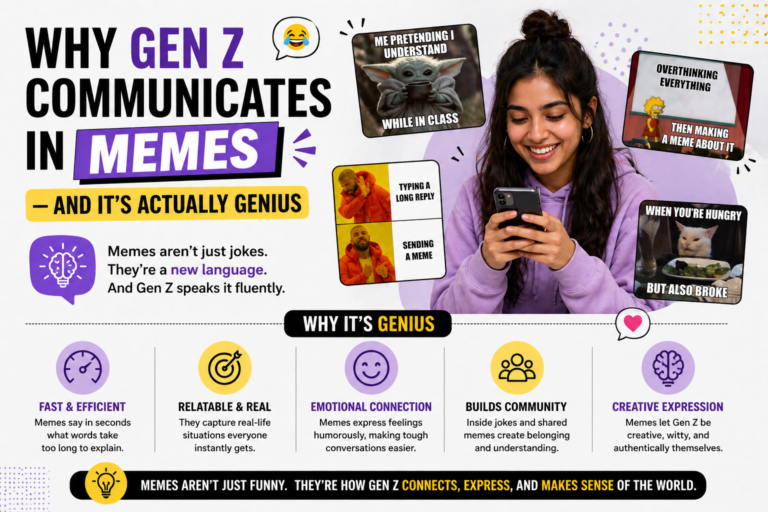
You’re scrolling through Instagram at 11 PM. You see a meme that perfectly captures how you feel about tomorrow’s economics exam. You laugh, send it to three friends, and suddenly — everyone feels seen. That right there is Why Gen Z Communicates in Memes, and it’s not laziness or shallow thinking. It’s a sophisticated new language built for the digital age.
At Gurukul PU College, we see this every day — students who struggle to write a 500-word essay but can explain capitalism’s flaws through a single distorted SpongeBob image. So we asked: what’s actually happening here? And the answer is fascinating.
1. Memes Are a Language, Not a Joke
The word ‘meme’ was coined by evolutionary biologist Richard Dawkins in his 1976 book The Selfish Gene to describe ideas that spread culturally — just like genes spread biologically. But Gen Z took that concept and supercharged it with the internet.
Modern memes are dense units of meaning. A single meme can communicate:
• Irony and sarcasm that would take paragraphs to explain
• Shared cultural references that build community
• Emotional nuance that plain text often flattens
• Critique of institutions, systems, and norms
This is why researchers at places like MIT Media Lab are studying meme culture seriously. Memes aren’t a distraction from communication — they are communication.
2. Gen Z Grew Up in the Age of Information Overload
The average person today encounters between 6,000 to 10,000 ads and pieces of content per day. Gen Z didn’t just grow up with smartphones — they grew up drowning in content. The result? Their brains learned to filter fast.
Memes are perfectly built for this environment:
• They deliver meaning in under 3 seconds
• They use visuals, which the brain processes 60,000x faster than text
• They layer multiple meanings simultaneously
• They require context — making them satisfying to decode
Did You Know? Studies show that visual information is processed 60,000 times faster than text. Memes aren’t dumbing things down — they’re upgrading delivery.
Gen Z’s so-called “short attention span” is actually high-speed filtering. They decide if something is worth their time within milliseconds. Memes are optimized for this. That’s not a bug — it’s an adaptation.
For a deep dive into how digital natives process information, check out this resource from Pew Research Center on Gen Z.
3. Memes Are Emotional Intelligence in Disguise
Here’s something that might surprise you: sharing a meme requires significant emotional intelligence. When a Gen Z student forwards a meme to a friend, they’re saying:
• I saw this and thought of you
• I understand how you are feeling right now
• We share this experience
• You are not alone in this
That’s empathy. Compressed into a 400×400 pixel image. The ability to identify the exact meme that captures a friend’s situation is a high-level social skill — one that many adults who dismiss memes entirely have not developed.
At Gurukul PU College: We’ve noticed that students who are fluent in meme culture often show stronger peer connection and emotional literacy than those who aren’t. It’s a pattern worth taking seriously.
4. Memes as Social Commentary and Activism
Gen Z uses memes to talk about things that matter: mental health, climate anxiety, caste discrimination, gender norms, and political corruption. A meme about “pretending to be okay” reaches a 16-year-old in a way that a 10-page psychology report never could.
During the COVID-19 pandemic, memes were one of the primary ways young people processed collective grief, anxiety, and absurdity. They weren’t being insensitive — they were coping. Psychologists have noted that humor has long been a healthy mechanism for dealing with trauma and uncertainty.
Organizations like UNICEF have even studied how youth use social media, including memes, to advocate for causes they care about. Gen Z doesn’t write op-eds — they make memes that go viral and shift public opinion.
5. What This Means for Education — And Why Gurukul PU College Is Paying Attention
If memes are a legitimate language, then educators need to take note. At Gurukul PU College, we believe that understanding how students communicate is the first step to teaching them more effectively.
Here’s what we’re seeing:
• Students retain concepts better when they can create a meme about them
• Peer learning accelerates when students share meme-based explanations
• Critical thinking develops when students analyze why a meme works (or doesn’t)
Some forward-thinking educators around the world are already using memes as classroom tools — and the results are promising. The key insight: meet students where they are, then take them further.
If you’re a student at Gurukul PU College looking to channel your creativity, check out our Student Life section and Campus Events page — we regularly host workshops where you can explore digital creativity and communication.
6. The Science Behind Why Memes Stick
Memory researchers have long known that emotion + visual + surprise is the ultimate memory combination. Memes hit all three:
This is why you can remember a meme you saw three years ago but forget a textbook paragraph you read yesterday. The brain is not broken — it’s working exactly as designed.
For more on the neuroscience of humor and memory, Scientific American has a great explainer worth reading.
7. The Genius Is Real — Here’s the Evidence
Let’s put it all together. Why Gen Z Communicates in Memes is not a mystery or a problem — it’s a feature:
• Efficient: Maximum meaning, minimum words
• Community-building: Shared memes = shared identity
• Emotionally rich: Layers of irony, empathy and nuance
• Viral by design: Built to travel and connect
• Cognitively demanding: Requires cultural literacy to decode
The next time an adult tells you that memes are “mindless,” show them this blog post. Better yet — make a meme about it.
Final Thoughts from Gurukul PU College
We’re living in a world where communication is evolving faster than ever. Gen Z is not behind — they’re ahead. Understanding Why Gen Z Communicates in Memes is understanding the future of human expression.
At Gurukul PU College, we celebrate students who think differently, express creatively and connect authentically. Whether you’re a meme lord or a essay writer — every form of intelligence has a home here.
Subcribe Our Newsletter
Work Hours
- Mon - Fri :
- Sunday :
- 10.00 AM - 05.30 PM
- Closed