

- +91 9606457774
- infogdc@gurukul.edu.in
- Mon - Sat : 09.30AM - 05.00PM
Picking a major is one of the biggest financial decisions you’ll ever make. If long-term stability matters to you as much as passion does, it pays to look at which fields keep hiring even when the economy wobbles. Below is a short, honest look at the best college degrees for job security, plus a practical starting point if you’re weighing your options for a business-focused degree.
Not every degree carries the same weight in the job market. Some fields are tied to industries that shrink and grow with the economy, while others – healthcare, core technology, finance, and education – tend to keep hiring because the underlying demand doesn’t disappear. Government labor data is a good reality check before you commit three or four years and a lot of tuition to any one path; the U.S. Bureau of Labor Statistics Occupational Outlook Handbook is a solid, free place to see real projected growth and pay by occupation.
Job security also comes down to how transferable your skills are. Degrees that teach a mix of technical know-how and people skills – reading a balance sheet, managing a team, communicating with clients – tend to hold up better across different employers and even different industries, which matters if your first job isn’t your last one.
● Nursing & Allied Health – aging populations and constant healthcare needs mean qualified graduates rarely struggle to find work.
● Accounting & Finance – every business, in every economic climate, needs someone managing its books, taxes, and compliance – one of the steadiest career tracks there is.
● Business Administration & Management – companies of every size need people who can run operations, manage teams, and make sense of budgets – skills that travel well between industries.
● Education – schools consistently need trained teachers and administrators, especially in growing cities.
For a broader, regularly updated view of which skills employers are actually hiring for, the World Economic Forum’s Future of Jobs Report is worth a read alongside the BLS data above. If you’re job-hunting in India specifically, the government’s own National Career Service portal is another useful, free resource for checking demand and openings by field before you finalize a major.
A stable field on paper still has to fit you. Before you decide, weigh three things: whether the day-to-day work actually interests you, whether colleges you’re considering offer strong, placement-focused programs in that field, and whether the degree keeps doors open if you later want to specialize or study further. A business or commerce degree, for example, is a good middle ground – broad enough to lead into finance, management, marketing, or your own venture, without locking you into one narrow job title.
If a business or commerce path from the list above sounds right for you, Gurukul Degree College in Kalaburagi focuses specifically on this space, offering BBA and B.Com programs built around practical, industry-ready skills rather than just theory. These two degrees map directly onto the accounting, finance, and management roles covered above, and they’re a solid fit if you’d rather graduate ready to work than spend a few extra years in a broader, more general program. You can see course details and placement information on the Gurukul Degree College programs page, which is a reasonable next step if this list has you leaning toward a business or commerce degree.
The college pairs its BBA and B.Com curriculum with industry links and campus placement support, so the goal isn’t just a degree on paper – it’s a program built with the job market in mind.
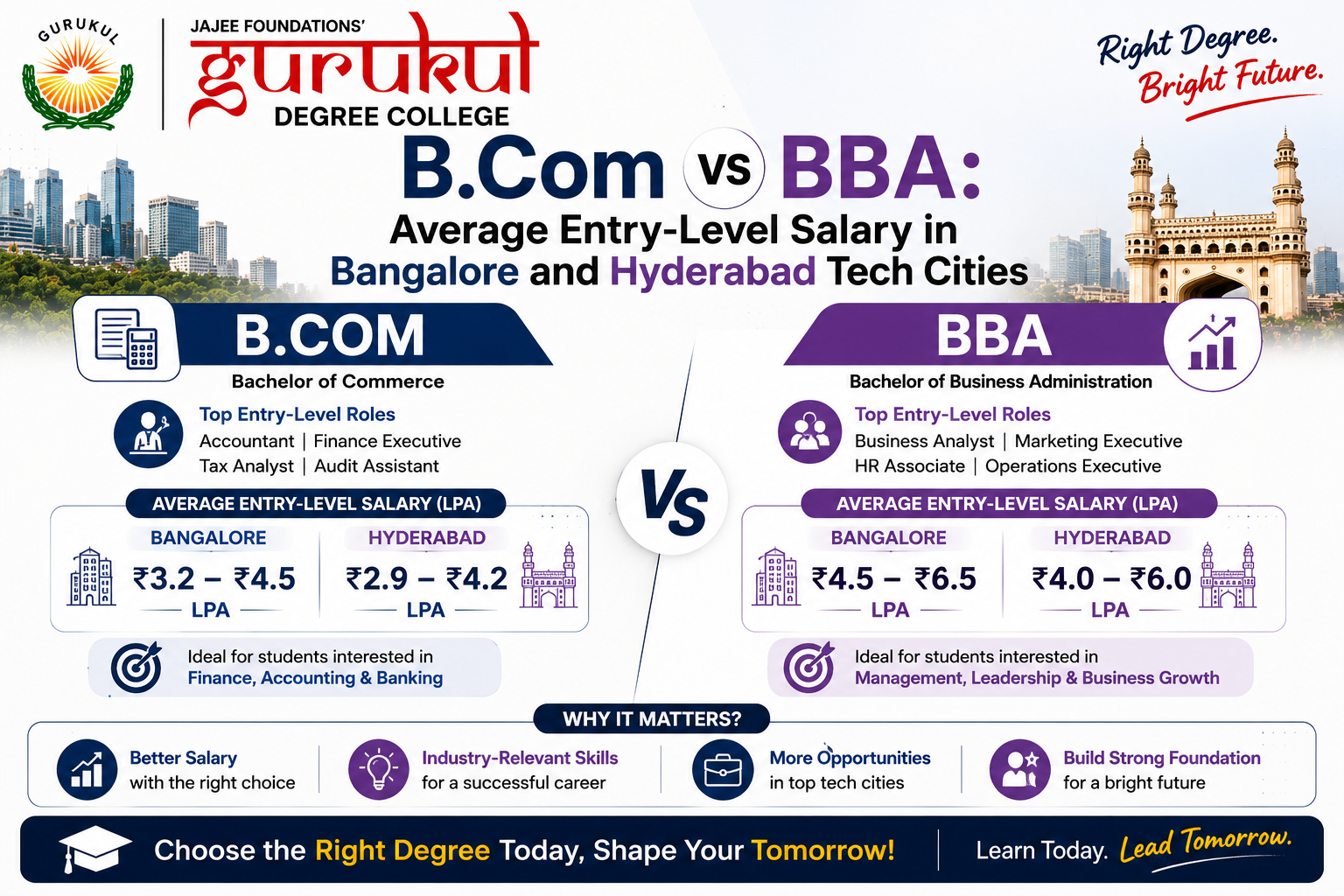
Is a BBA or a B.Com better for job security? Both hold up well. A B.Com leans toward accounting, taxation, and finance roles, while a BBA leans toward management and operations. Your choice should follow which day-to-day work interests you more.
Do I need a master’s degree for job security? Not necessarily. A focused undergraduate degree with real placement support can offer solid stability on its own; a master’s helps more with faster progression than with job security itself.
Does the college I attend matter as much as the degree? Yes. Two graduates with the same degree can have very different outcomes depending on placement support, industry tie-ups, and practical training – worth checking before you enroll anywhere.
No degree comes with a guarantee, but some paths clearly stack the odds in your favor. Use labor market data, talk to graduates working in the field, and pick a program that pairs solid fundamentals with real hands-on training. That combination is what actually turns a degree into a stable career.




Stay Updated with Gurukul Degree College