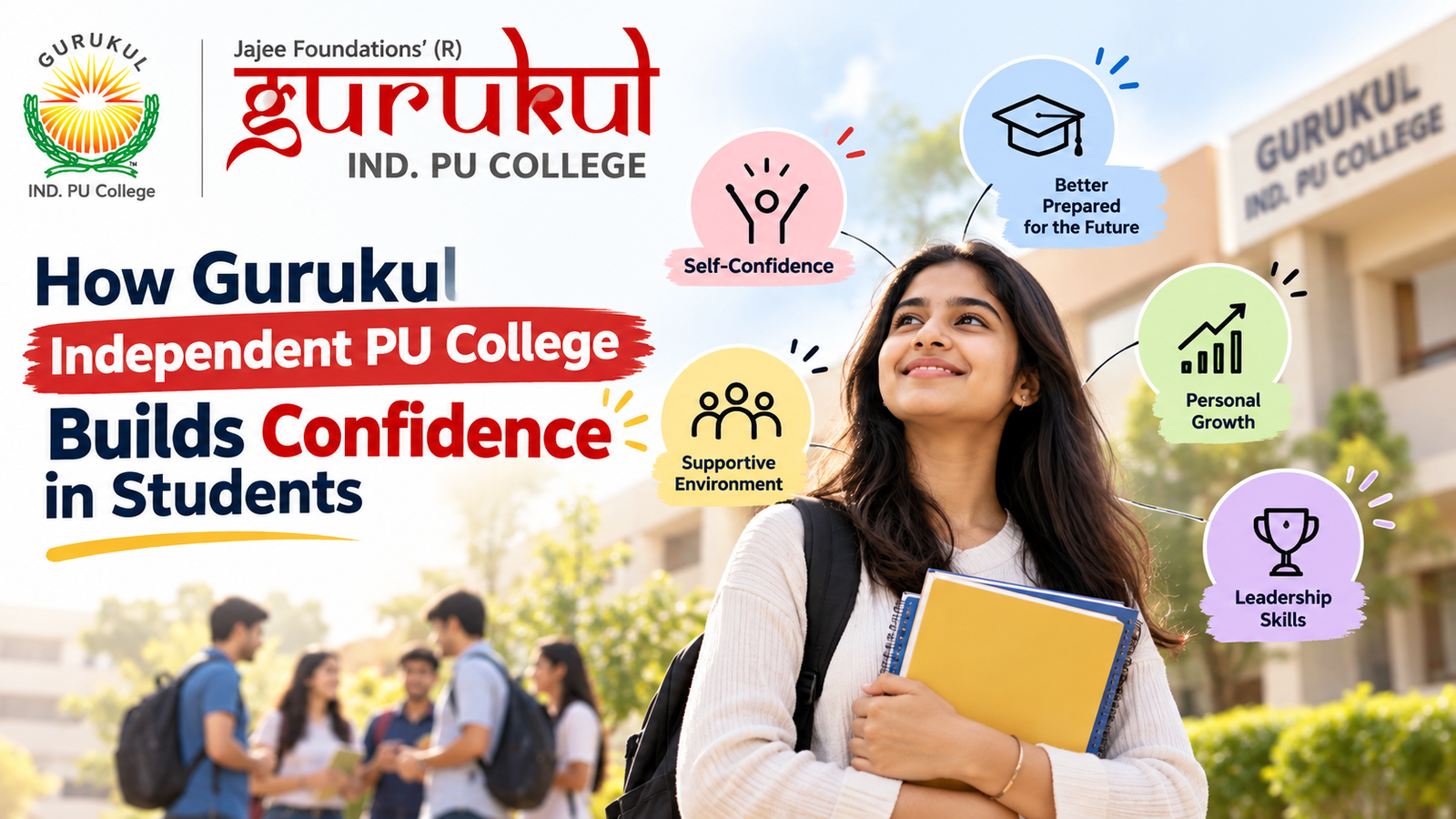
How Gurukul Independent PU College Builds Confidence in Students
New Jajee Block
+91 9481717459
infogpu@gurukul.edu.in

Picking a PU college feels like a fairly small decision when you’re sixteen and still sorting out what SSLC results actually mean for the rest of your life. But it isn’t small. The two years right after Class 10 quietly decide which subjects you get comfortable with, which entrance exams you’re prepared for, and how confident you walk into a college interview four years down the line. That’s exactly why so many parents in Kalaburagi spend weeks weighing every option before settling on one — because finding the best PUC college is really about choosing the shape of the next decade, not just the next two years.
This piece looks at what actually separates a good PU college from an average one, how to think about the Science versus Commerce decision, and where Gurukul Independent PU College fits into that picture for families in North Karnataka.
Class 11 and 12 aren’t just “board exam prep.” They’re where habits form — how a student handles pressure, manages a timetable, and picks up (or avoids) the discipline needed for competitive exams like NEET, JEE, or CA Foundation later. A college that only focuses on marks and ignores mentorship tends to produce students who do fine in the PUC exam and then struggle the moment they’re on their own in a professional course or bachelor’s degree.
That’s the real argument for taking the “which college” question seriously. The right environment at this stage doesn’t just help with the 2nd PUC result — it builds the study habits, subject clarity, and self-belief that carry into engineering, medicine, law, commerce, or whatever comes next.
Ask ten families what they look for and you’ll get ten different answers — fees, distance from home, results, “reputation.” A few things matter more than the rest:
None of these show up clearly on a brochure. They usually take a campus visit, a conversation with current students, or a look at how the faculty talk about their subjects to actually notice.
This is usually the first real fork in the road, and it’s worth thinking through rather than defaulting to whatever a friend picked.
Science suits students who enjoy problem-solving and want to keep the door open for engineering, medicine, or applied technology. Combinations like PCMB, PCME, and PCMC — Physics, Chemistry, Mathematics paired with Biology, Electronics, or Computer Science — each lead down slightly different paths, from NEET-focused medical prep to JEE-focused engineering prep to software and IT careers.
Commerce fits students drawn to business, numbers, and how organizations actually run. Combinations such as SEBA, CEBA, and SMBA build the groundwork for Statistics, Economics, Business Studies, and Accountancy-based careers in CA, CS, BBA, and finance.
Neither stream is “harder” or “safer” than the other — they’re just built for different strengths. A student who’s comfortable with ambiguity and enjoys case-study style thinking usually settles into Commerce faster, while a student who likes precise, testable answers tends to lean toward Science.
Gurukul Independent PU College, run under the Jajee Foundation in Kalaburagi, has built its reputation over more than a decade around exactly the fundamentals mentioned above. The college is affiliated with the Karnataka Pre-University Education Board and runs dedicated Physics, Chemistry, Biology, and Computer Science labs to support both its Science and Commerce streams. You can see how the college describes its own approach on its About Us page.
Beyond the classroom, the college runs focused coaching for NEET, JEE, KCET, and CA-CPT for students aiming at competitive exams, alongside merit-based scholarships for students who need a bit of financial support to get there. Faculty mentorship is treated as part of the job, not an afterthought — something current students and parents can verify directly by speaking with the faculty team or sitting in on a campus visit.
For families comparing options in Kalaburagi, that combination of board compliance, stream-specific infrastructure, and exam-focused coaching is a reasonable starting checklist — and it’s worth verifying directly with any college you’re considering, Gurukul included.
It’s tempting to treat PUC as just two years to get through before “real” education starts. In practice, it’s the foundation everything after it sits on. Whatever degree program a student eventually joins — engineering, medicine, commerce, arts — falls under the regulatory framework of bodies like the University Grants Commission, which sets the standards Indian universities and colleges are expected to meet. Students who arrive at that stage with strong subject fundamentals and exam discipline from their PUC years tend to adapt faster, because they’re not learning how to study at the same time as learning the syllabus.
Similarly, for Science students aiming at NEET or JEE, those exams are conducted by the National Testing Agency, and the difference between a rushed last-minute prep and two years of steady, lab-supported foundation work usually shows up in the result.
Choosing the best PUC college for your child isn’t about chasing the college with the biggest hoarding around town — it’s about matching the right environment, stream, and support system to the student in front of you. For families in Kalaburagi weighing that decision, Gurukul Independent PU College offers a Karnataka PUE Board–affiliated, dual-stream campus with the lab infrastructure and exam coaching to back it up. If you’re at that stage of the decision, it’s worth reaching out directly to talk it through.
We’re here to guide and support you! Whether you have questions about admissions, academics, campus life, or Kalaburagi PU College for students, feel free to reach out.
The best PUC college offers experienced faculty, modern laboratories, Karnataka PUE Board affiliation, excellent academic results, career guidance, and a supportive environment that helps students succeed in higher education and competitive exams.
Yes. Most leading PUC colleges offer Science combinations such as PCMB, PCMC, and PCME, along with Commerce combinations like SEBA, CEBA, and SMBA to suit different career goals
Yes. Many top PUC colleges provide integrated coaching and academic guidance for NEET, JEE, KCET, and CA Foundation while ensuring students perform well in their board examinations.
Compare colleges based on board affiliation, faculty experience, Science and Commerce stream options, infrastructure, scholarships, academic performance, and competitive exam support before making your decision.
Choosing the best PUC college helps students build strong academic foundations, develop study skills, prepare for entrance exams like NEET, JEE, and CA Foundation, and improve future career opportunities.
The best PUC college should provide smart classrooms, well-equipped Physics, Chemistry, Biology, and Computer Science laboratories, experienced faculty, libraries, sports facilities, career counselling, and extracurricular activities.